
Chimney Flashing and Repointing: Why Most Leaks Start at the Chimney
Posted by John Price August 1st, 2026
Chimney junctions carry more concentrated water load than almost any other part of a roof, which is why the vast majority of “roof leaks” homeowners report are actually chimney-related rather than tile or felt failures further down the slope. Understanding the two systems that protect a chimney — lead flashing and mortar pointing — helps homeowners recognise problems early and understand exactly what a proper chimney repair involves.

Why Chimneys Are The Weak Point Of Any Roof
A chimney stack punctures the roof plane, creating a junction where two very different materials — brick masonry and roof covering — have to be sealed together while both move independently with temperature and weather. This junction faces wind-driven rain from multiple directions, freeze-thaw cycling, and constant thermal expansion and contraction, all of which stress the mortar joints and flashing details far more than a flat, uninterrupted roof slope. As a result, chimney-related leaks are consistently traced back to flashing defects or failed pointing rather than problems with the roof tiles themselves.
The Anatomy Of Chimney Flashing
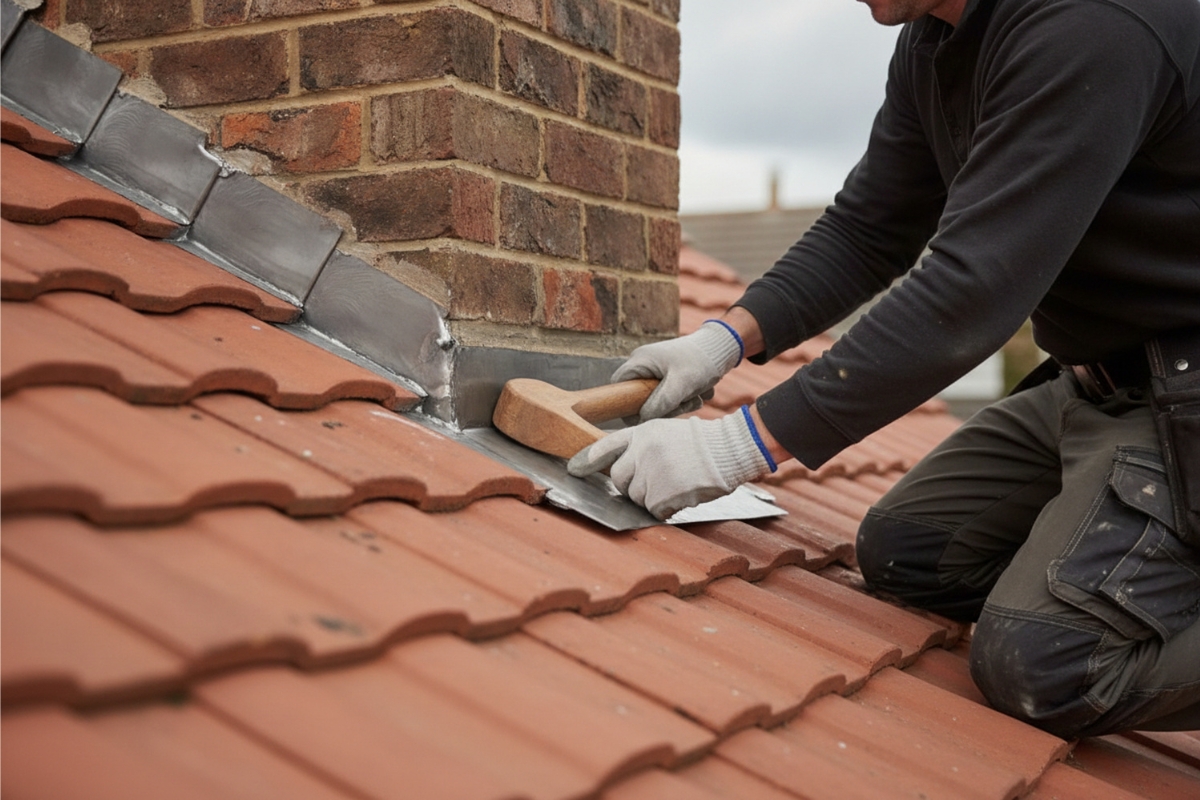
A full chimney flashing arrangement is rarely a single piece of lead. It’s a coordinated system of components, each weathering a different part of the stack:
- Front apron flashing: covers the downhill face of the chimney and projects water back out over the roof covering below.
- Side step flashings: stepped lead pieces cut to follow the brick courses, weathering each side (“cheek”) of the stack without needing to cut bricks.
- Back gutter (or cricket): sits on the uphill side of the chimney and channels the highest water volume around the stack, since this is where rainwater running down the roof slope meets the obstruction.
- Soakers: smaller lead pieces beneath the side step flashings that work with the tiles to shed water at each course.
Lead thickness matters here. Front aprons typically use Code 4 or Code 5 lead depending on width and exposure, side step flashings are commonly Code 4, and back gutters — which handle the greatest water load — often justify a heavier Code 5 or above. Using undersized lead in high-exposure areas is a common cause of premature flashing failure.
How Mortar And Pointing Fit Into The Picture
Mortar joints between the chimney’s bricks are designed to flex and weather over decades, but they are also the first areas to crack, erode, or crumble as they’re directly exposed to rain, frost, wind, and UV. Once a joint fails, water tracks into the joint and, during freeze-thaw cycles, expands and contracts, progressively loosening bricks and widening the gap. This is a slow-building problem: repointing early — replacing failed mortar with fresh, correctly specified mortar — restores the joint and protects the chimney from further water ingress before it reaches the stage of loose or spalling brick.
Flaunching, the mortar layer at the top of the stack that holds the chimney pots in place, deserves separate attention. If it cracks or breaks away, rain and snow can enter directly down the flue and track into the roof void, producing a leak that has nothing to do with the flashing at all.
One detail worth flagging to clients: cement pointing applied over older lime mortar tends to trap moisture rather than let it evaporate, which accelerates frost damage and brick spalling. Lime mortar (commonly NHL 3.5 or NHL 5) is generally the correct specification for older or listed chimneys because it remains permeable and flexes with the structure.
Diagnosing Where A Chimney Leak Is Actually Coming From
Because a chimney has multiple failure points, an accurate diagnosis has to work through them systematically rather than assuming the first visible defect is the cause. A practical ground-and-loft diagnostic sequence:
- Ceiling stain appearing near the stack — most often points to step flashing or back gutter failure.
- Damp inside the chimney breast with no obvious roof leak — check for rain entry down the flue itself; a missing or damaged rain cap is a common culprit.
- Cracked or missing mortar in the flashing chases — the lead itself may be sound and only need re-bedding and repointing at the chase line.
- Debris visible in the back gutter or valley behind the stack — a blocked back gutter is one of the most common and most overlooked leak sources, since debris redirects water sideways into the roof structure instead of around it.
- Visible cracks in flaunching or a missing chimney pot cap — points to water entering via the flue rather than the roof junction.
This order matters because the roof above the chimney, the flashing itself, the flashing-to-brick transition, the masonry face, and the pot/cap are progressively less likely culprits, in roughly that sequence, based on typical failure patterns.
What A Proper Repair Involves
Repair scope depends entirely on what the diagnosis finds:
- If the lead is intact and only the mortar chase has failed, repointing alone resolves the issue — no need to disturb the flashing.
- If the lead has come loose from the wall chase but is otherwise undamaged, it should be re-dressed back into the chase, secured with lead wedges, and resealed — using a flexible lead sealant rather than mortar, since mortar cracks and falls out as the lead naturally expands and contracts with temperature, while sealant flexes with it.
- If the lead itself is split or corroded, replacement is required rather than a surface repair — patching split lead with sealant is a temporary bodge, not a fix.
- Checks should also cover soaker condition, the amount of lap on each step flashing, head lap over soakers, and whether a chimney tray is fitted beneath the flashing as a secondary line of defence.
Cost ranges vary by region, but UK homeowners can generally expect flashing repair or replacement in the £250-£1,200 range and repointing from around £500 depending on scale, giving a useful benchmark when scoping a job for a client.
The Takeaway For Homeowners
A chimney leak is rarely a single-cause problem — it’s usually a combination of ageing mortar, worn lead, and debris build-up all interacting at one of the most weather-exposed points on the roof. A full inspection covering flashing, pointing, flaunching, and the back gutter is the only reliable way to identify the actual entry point before committing to a repair, which is why chimney work should always start with a proper diagnostic survey rather than jumping straight to a patch repair.

John Price, the owner of JP Roofing Services, is an experienced roofing expert with deep roots in Nottinghamshire. Leading a family-owned business, John has built a reputation for excellence in the local roofing industry. JP Roofing Services offers a comprehensive range of services, including new roof installations, repairs, and maintenance, with specialisations in flat roofs, guttering, fascias, soffits, and chimney work. John’s commitment to reliability, punctuality, and affordable pricing without compromising on quality has made JP Roofing Services a trusted name in the community. With a focus on safety and customer satisfaction, John ensures that every project meets the highest standards, combining traditional values with modern expertise.


